Contents
DISCeRN
Digital markers of social cognition for diagnosis and prognosis in neurodegenerative diseases
DISCeRN develops digital markers of social cognition to improve differential diagnosis and prognosis in neurodegenerative diseases, combining AI, clinical neuropsychology and brain imaging.
Status
In progress
Context
The proportion of older people is rising in almost every country. By 2050, nearly two billion people worldwide will be aged 60 or over. Neurodegenerative diseases are now the seventh leading cause of death across all pathologies and one of the main causes of disability and dependence in older adults globally.
The impact of these diseases is considerable — not only for those affected, but also for their relatives, caregivers and, more broadly, for society as a whole.
Among cognitive disorders, difficulties in interacting with others rank among the most disabling. Difficulties in understanding others’ emotions, interpreting social signals or sustaining meaningful interactions strongly contribute to the loss of social inclusion and the decline in quality of life for people with neurodegenerative diseases.
Yet these very frequent difficulties are still poorly assessed in neurology and insufficiently accounted for in patient follow-up. Existing clinical tests — including those developed by our team and now used internationally — only partially fill this gap and remain distant from the concrete problems faced by people and their families.
Objectives
The DISCERN project, which brings together 11 expert centers across the world, aims to better understand and evaluate social difficulties linked to neurodegenerative diseases.
- Harmonizing neuropsychological practices to improve the detection of these disorders
- Detecting early changes in daily social interactions by analyzing facial expressions, vocal variations, speech patterns, and gestures during real conversations
- Comparing these data with traditional clinical assessments and brain imaging
- Better describing the social impacts of interaction disorders: withdrawal, isolation, vulnerability, and the difficulties faced by loved ones
- Better understanding the role of various factors (social isolation, education level, living conditions, environment) in the onset and progression of these social difficulties
Methodology
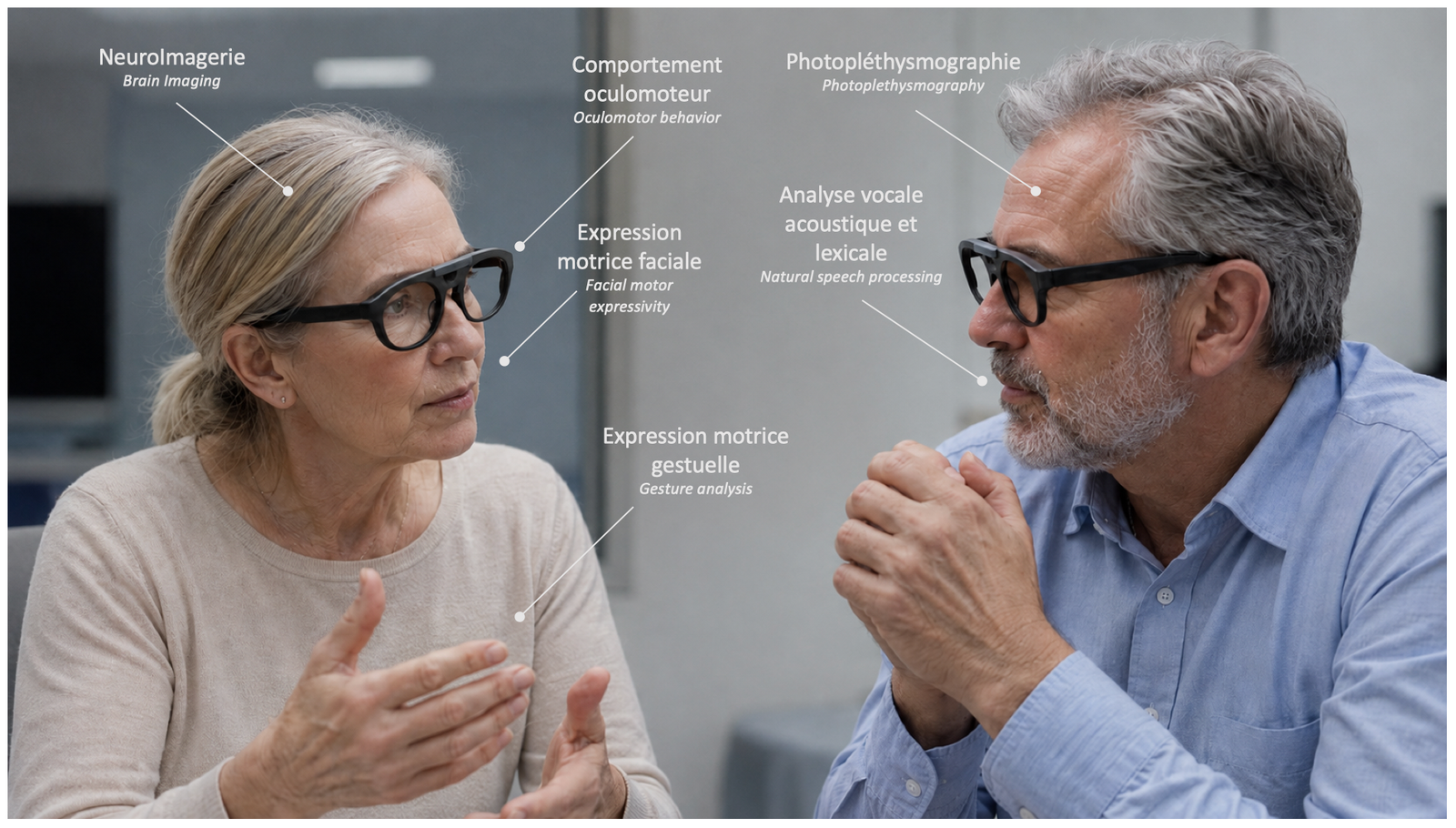
DISCeRN analyses facial expressions, voice variations, speech patterns and gestures during real conversations. These data are compared to standard clinical assessments and brain imaging.
An international collaboration
DISCeRN is coordinated by our team and supported by the Joint Programme for Neurodegenerative Disease (JPND) of the European Union and, in France, by the French National Research Agency (ANR).
Built on a collaboration between 8 world specialists in neurodegenerative diseases, brain health and social cognition, it brings together:
- expert patients and associations such as World FTD United;
- leading universities such as McGill University (Montréal) and Trinity College Dublin (Ireland);
- scientific networks of excellence such as the Neuropsychiatric International Consortium on Frontotemporal Degeneration (NIC-FTD) and the Multi-Partner Consortium to Expand Dementia Research in Latin America (ReDLat);
- global health initiatives such as the Global Brain Health Institute (GBHI).
Coordinator

Partners












Related projects